
How the tide decides a Komodo dive day
Why the same site is a gentle drift at nine and a washing machine at noon, and what the two monsoons do to the north and the south.
Topics: Conditions, Seasonality, Planning
The water in the dry season

Scroll sideways
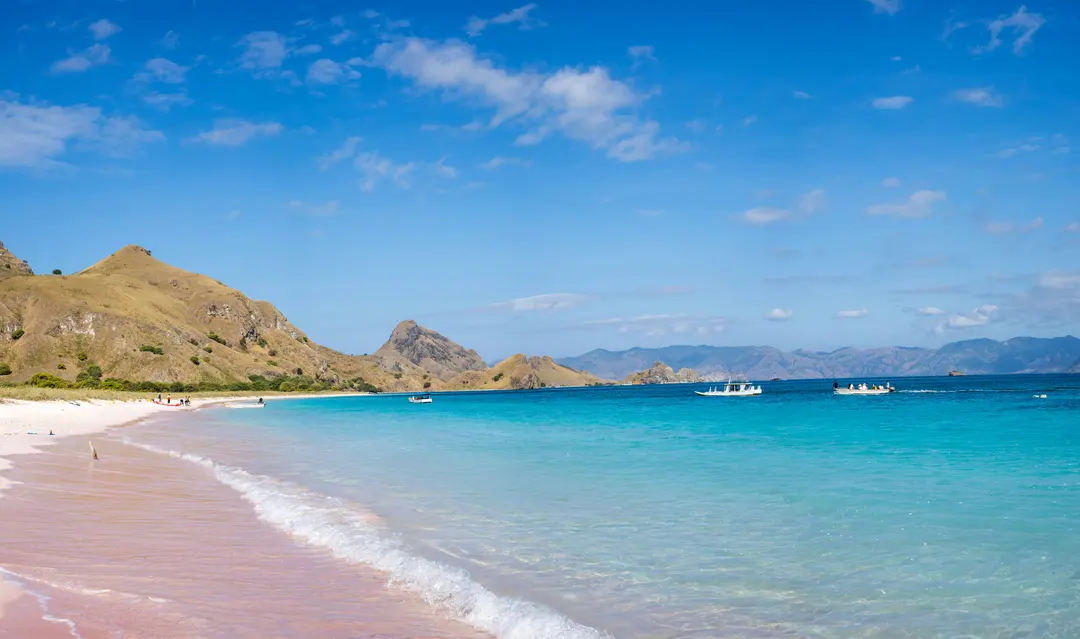
Pale sand and turquoise shallows in the dry season, when the south is windier and the north is calm.
The Komodo straits move an enormous amount of water twice a day, and the dive plan is a consequence of that. Two sites a kilometre apart can be flat and unfriendly at the same hour, because one faces the flow and the other is in its lee.
Slack is a window, not an hour
At Batu Bolong the usable slack around a predicted turn is usually twenty to thirty minutes on a neap tide and shorter on a spring. Miss it and the dive changes character: still divable, but a drift rather than a wall, and the brief changes with it.
The tide range here is around two metres on a spring, which does not sound like much until it is funnelled between two islands. That is why the crew reads the tide table before the weather forecast.
Moon, wind and the two monsoons
The southeast trades run roughly June to September. They bring dry air, flat water on the north and central sites, and enough wind on the south side to make the crossing unpleasant. The northwest monsoon, December to March, reverses it: rain, greener water in the north, and calm on the south.
That is the useful trick of the park. The south is at its best when the north is not, and the other way round. A trip planned for January should be heading south; a trip planned for August should be in the north and centre.
Visibility
Fifteen to thirty metres is the normal range, and it is driven by plankton rather than by sediment. The upwelling that brings the mantas to the south also brings the green water, so the best manta dives are rarely the clearest ones. In the north, the dry season gives the most consistent blue.
Booking around it
High season is TBA, when a surcharge of TBA applies and the good boats fill months ahead. The shoulder weeks either side of that window are quieter, and often have better water than the peak, because the wind has not arrived yet or has just left.
What this means for a plan
Pick the half of the park that matches the month, then let the tide pick the site. A fixed list of sites promised months in advance is a marketing document, not a dive plan.